Friday, July 13, 2007

Chinese Mitten Crab

Public urged to report Chinese mitten crabs
The Chinese Mitten Crab

Live Chinese Mitten Crabs (Eriocheir sinensis) have been caught in crab pots in Chesapeake Bay (2005-2007) and Delaware Bay (May 2007). These are the first confirmed reports for the eastern United States. To date, there have been seven crabs documented, and five have been in the past two weeks.

“We don’t yet know whether the crab has established reproductive populations in these estuaries or spread to other locations along the eastern U.S.,” said a marine official.

The Chinese Mitten Crab is native to East Asia, and is a potential invasive that could have negative ecological impacts. Mitten crabs are already established invaders in Europe and on the West Coast of the United States. The crab is listed as injurious wildlife under the Federal Lacey Act, which makes it illegal in the United States to import, export, or conduct interstate commerce of mitten crabs without a permit.

The Chinese Mitten Crab occurs in both freshwater and saltwater. It is catadromous, migrating from freshwater rivers and tributaries to reproduce in saltwater. Young crabs spend 2-5 years in freshwater tributaries and can extend miles upstream of bays and estuaries. Mature male and female crabs migrate downstream to mate and spawn in saltwater estuaries. Chinese mitten crabs burrow into banks and levees along estuaries and are able to leave the water to walk around obstacles while migrating.

To determine the status, abundance, and distribution of this species along the eastern U.S., a Mitten Crab Network has been established. The network began as a partnership among several state, federal, and research organizations, with an initial focus on Chesapeake and Delaware bays. The network is now being expanded to include resources managers, commercial fishermen, research organizations, and citizens along the eastern U.S.

Citizens are asked to help by reporting any mitten crabs to the Network or to a state resource manager.

The mitten crab has claws equal in size with white tips and hair; carapace up to 4 inches wide; light brown to olive green in color; no swimming legs; and has eight sharp-tipped walking legs.

If you catch a mitten crab: do not throw it back alive; freeze the animal, keep it on ice, or preserve it in rubbing alcohol as a last resort; note the precise location and date where the animal was found; please take a close-up photo of the animal, and email to SERCMittenCrab@si.edu for preliminary identification (include contact information); and if you cannot take a photo, contact the Mitten Crab Hotline (443-482-2222).

Thursday, July 5, 2007

Bill Limiting Pa. Farm Owners' Liability for Hunting Accidents On Gov.'s Desk

Bill Limiting Pa. Farm Owners' Liability for Hunting Accidents On Gov.'s Desk

July 5, 2007

A bill limiting Pennsylvania farmers' liability for hunting accidents on their properties has flown through the House and Senate and been sent to Gov. Edward Rendell for signing.

Advertisement

The measure was backed by Pennsylvania Farm Bureau, which sought to strengthen an existing law that provides liability protection for farmers and other landowners who allow hunters on their land.

House Bill 13 would amend the Recreational Use of Land and Water Act (RULWA) of 1965 by increasing protection for landowners from liability for injury or property damage caused by hunters that occurs off the landowner's property.

The law already provides landowners liability protection for actions that occur on their property as a result of recreational activities such as hunting, fishing, swimming and hiking.

But farmers sought to clarify the law in the wake of a 2006 court case in which the owner of a Lehigh County orchard was found partially liable for damages for a situation where a stray bullet fired by a hunter traveled about a half-mile before accidentally striking a woman sitting in a car on a different property.

PFB argued that many farmers would choose to limit or exclude hunters from their property if they could not re not sure of protection from liability.

"Pennsylvania farmers need assurances that they will not put their property and livelihood at risk when they allow hunters on their land. This bill should ease their concern," said PFB President Carl T. Shaffer.

The Virginia Marine Resources Commission soon will begin collecting carcasses of several elusive species _ cobia, spadefish, sheepshead, red and black

July 2, 2007 - 11:22am

By DENA POTTER
Associated Press Writer

RICHMOND, Va. (AP) - Next time you slice up your favorite saltwater fish, consider donating its carcass to science.

The Virginia Marine Resources Commission soon will begin collecting carcasses of several elusive species _ cobia, spadefish, sheepshead, red and black drum, tilefish and grouper _ from recreational fishermen to study the health of the fish populations.

Since 1998, the commission has collected length, weight, sex and age information from more than a dozen species in the Chesapeake Bay. The majority of the samples come from the commercial fishing industry, but some of the species aren't popular commercial catches, so the commission is turning to recreational fishermen to fill the gaps.

"Instead of going out and catching live ones ourselves, we can get much of the data that we need from the remnants of what's already caught," VMRC spokesman John Bull said.

Scientists must remove a fish's otolith, an ear bone that contains growth rings similar to rings in the trunks of trees, to determine its age. Hundreds of samples are needed each year for researchers to get an accurate reflection of the population.

"Why go and kill new fish to do the studies when we can learn the stuff from the dead fish?" Bull said. "That leaves more fish out there for other people to catch."

Bull called the project a "normal, routine, health-of-the-species population assessment" and said scientists have no reason to believe any of the targeted species are in serious danger.

Researchers are interested in how long the fish are living, how big they're growing and other details such as the ratio of females to males to determine what that might mean for the viability of the species.

The project targets fish that are most difficult to catch. Species such as flounder and striped bass are prevalent in the Chesapeake Bay, but the targeted fish either don't flock to the bay in large numbers or don't bite as well, Bull said.

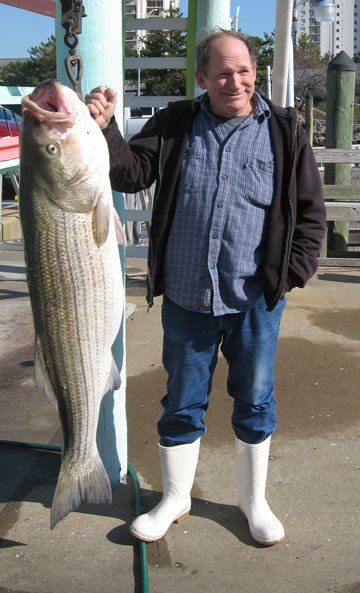
Last year, 26,000 cobia were recorded caught by recreational fishermen, and all but about 8,000 were released, Bull said. In contrast, recreational fishermen caught more than 67,000 striped bass during a four-week season last year in Maryland alone.

A project set up last year to collect sheepshead carcasses produced only 174 donations, said Hank Liao, a scientist at Old Dominion University's Center for Quantitative Fisheries Ecology. VMRC funds the center's Growth and Age Lab where last year Liao and another full-time scientist examined about 6,000 fish in 2006.

Liao said anywhere from 200 to 1,000 fish carcasses are needed to get a proper scientific sample, depending on the species. Some like striped bass live longer, so more samples are needed to get an accurate reflection of the population. Others like spotted seatrout have very short lifespans and only about 250 are required for study.


Cobia remain one of the most elusive. Last year, scientists had only 30 samples to study, Liao said.

"Each year we have to put a specific effort to go to a cobia tournament to collect fish from recreational fishermen," Liao said. "We never get enough."

But organizers of the Marine Sportfish Collection Project are hoping anglers will come to them.

Recreational fishermen will be able to drop off carcasses _ head and tail intact _ in freezers located at several bait shops spread out across the Chesapeake Bay area. They will receive a T-shirt in return.

Bull only hopes anglers will package the remains neatly.

"Hopefully they're not all just dumping their fish skeletons in a freezer and walking away," he said.

The project will continue indefinitely.

If you have fish to donate, you can take them to to the following bait and tackle shops: Wallace's Bait and Tackle in Hampton; Long Bay Pointe Marina in Virginia Beach; and Chris' Bait and Tackle in Capeville.


Friday, June 22, 2007

Bears on the move in VA


This 200-pound black bear was struck by a car and killed recently in Gloucester.

Last week Penny Reed of Jamaica was driving toward Gloucester County on Route 17 at Glenns when she struck the bear with her car and killed it. She was near the EVB Bank building in Glenns.

Authorities said the bear was a young black male and could have been roaming in search of a mate and had just roamed too far off course. Last week black bears also were spotted in King and Queen and even the suburbs of Richmond.

Reed said the bear looked like a “big shadow in the night” crossing the road and then there was a “big bang” when she hit it. “I knew it was more than a shadow then,” she said.

“I’m not surprised it was a young male,” said a representative from the Virginia Department of Game and Inland Fisheries in Richmond. “This is the breeding season and yearling males are out trying to find their own territory because they have been pushed out by older males. We get a lot of movement in the bear community this time of the year.”

Game department statistics show bears occur in at least 92 of Virginia’s 98 counties and cities. For more information and tips about what to do if you see a bear in our area, check the game department web site at dgif.state.va.us.

Dog Hunting

Heat from dog-hunting issue generates plan to take action
Friday, Jun 22, 2007 - 12:06 AM
By LEE GRAVES
TIMES-DISPATCH COLUMNIST

Denny Quaiff used to rank Sunday hunting as the most volatile issue among hunters. No longer. "Since this has been on the table, I've had more correspondence on this than I ever had on Sunday hunting," he said. The issue is hunting deer with dogs, and Quaiff, who is executive director of the Virginia Deer Hunters Association, is among a group of key players hoping to quiet the baying that's developed between various factions.

"Our position is to work with the [Virginia] Department of Game and Inland Fisheries on this and see if there isn't some way to improve the situation," he said. "We're not in any way, shape or form wanting to abolish deer hunting with dogs, but we recognize that there are some problems here and they need to be addressed."

Bob Duncan, director of the wildlife division of VDGIF, said he plans to propose at the July 17 board meeting that a process be initiated similar to the one used to develop the state's long-term deer and bear management plans.

The first step would be a series of focus groups to identify issues. Landowners, bear hunters, deer hunters, fox hunters - all will be considered, Duncan said.

Those concerns would be addressed by an advisory committee made up of a cross-section of stakeholders. Using technical support from VDGIF staff members, the group would draft recommendations that would be reviewed by the board and the public. A final report would follow that could include potential legislation to be considered in the 2009 General Assembly.

Duncan and his staff already have fashioned a proposed objective: "To provide a diversity of opportunities for hunting with hounds in Virginia in a manner that's fair, sportsmanlike and consistent with the rights of private property owners and other citizens."

The dog-hunting issue went from a bubble to a boil this spring. In April, the VDGIF Web site posted preliminary staff recommendations about regulatory amendments. Only one mentioned dogs, and it suggested using a tracking dog on a leash to retrieve wounded deer.

One citizen's recommendation, however, led to an online forum with hundreds of postings.

The issue gained momentum in board meetings and in a letter sent by the Virginia Deer Hunters Association to members in May. The letter cited regulations adopted in Florida and Georgia and legislative efforts in South Carolina.

"We've got the same issues alive and very well here in South Carolina that you do in Virginia," Charles Ruth said in a phone interview this week. He's deer and turkey project leader in South Carolina, where regulatory changes are determined by the state's legislature, not the game department.

State law for years has allowed deer hunting with dogs in South Carolina's Coastal Plain but not the Piedmont. As in Virginia and elsewhere, Ruth said, large tracts of land have shrunk, tightening the collar on the space that dogs have to hunt.

A bill introduced in the South Carolina Senate proposed changes akin to those adopted four years ago in Georgia. The measure rests in a subcommittee.

"I think that was more of a message being sent out that [legislators] are tired of hearing about the complaints," Ruth said.

Georgia's requirements essentially are three-fold:

  • Anyone owning or leasing property where dogs are to hunt needs a permit.
  • The property must contain at least 1,000 contiguous acres.
  • All dogs and vehicles used in the hunt must be identified with their permit numbers.

    Todd Nims, a Georgia wildlife biologist who runs the permitting program, said complaints have decreased since the regulations took effect.

    Last year, warning letters went out to two clubs out of 333 groups that had received permits on 398 tracts of land. That's less than 1 percent and consistent with the trend, Nims said.

    "There are certain clubs that have always been the problem, and those are the ones that are getting ferreted out," he said. "The ones that go out there and do things right have not been a problem whatsoever."

    In Florida, dogs and property must be registered, dogs must be kept on registered property and restrictions are placed on training periods.

    At the VDGIF board's March meeting, a Gloucester resident suggested following Georgia and Florida's lead because residential growth in parts of Virginia has created conflicts in densely populated areas.

    Quaiff is not comfortable with Georgia's 1,000-acre rule, but he acknowledges something needs to be done. Roughly half the association's members hunt with dogs.

    "It's the kind of thing we can't bury our head in the sand over," Quaiff said. "I think we can put something together that will be meaningful for everybody and preserve dog hunting in the right way for a long time."


    Contact Lee Graves at (804) 649-6579 or outdoors@timesdispatch.com.

  • Sunday, June 3, 2007

    Great blog on Working Terrriers

    http://terriermandotcom.blogspot.com/

    Saturday, May 26, 2007

    Hogzilla 2


    http://www.wtopnews.com/?nid=456&pid=0&sid=1150599&page=1


    http://news.mywebpal.com/partners/680/public/news809759.html

    By KATE BRUMBACK
    Associated Press Writer

    MONTGOMERY, Ala. (AP) - Hogzilla is being made into a horror movie. But the sequel may be even bigger: Meet Monster Pig. An 11-year-old boy used a pistol to kill a wild hog his father says weighed a staggering 1,051 pounds and measured 9 feet 4, from the tip of its snout to the base of its tail. Think hams as big as car tires.

    If the claims are accurate, Jamison Stone's trophy boar would be bigger than Hogzilla, the famed wild hog that grew to seemingly mythical proportions after being killed in south Georgia in 2004.

    Hogzilla originally was thought to weigh 1,000 pounds and measure 12 feet long. National Geographic experts who unearthed its remains believe the animal actually weighed about 800 pounds and was 8 feet long.

    Regardless of the comparison, Jamison is reveling in the attention over his pig.

    "It feels really good," Jamison said in a telephone interview with The Associated Press. "It's a good accomplishment. I probably won't ever kill anything else that big."

    Jamison, who killed his first deer at age 5, was hunting with father Mike Stone and two guides in east Alabama on May 3 when he bagged Monster Pig. He said he shot the huge animal eight times with a .50-caliber revolver and chased it for three hours through hilly woods before finishing it off with a point-blank shot.

    Through it all, there was the fear that the animal would turn and charge them, as wild boars have a reputation for doing.

    "I was a little bit scared, a little bit excited," said Jamison, who lives in Pickensville on the Mississippi border. He just finished the sixth grade on the honor roll at Christian Heritage Academy, a small, private school.

    His father said that, just to be extra safe, he and the guides had high-powered rifles aimed and ready to fire in case the beast, with 5-inch tusks, decided to charge.

    With the animal finally dead in a creek bed on the 2,500-acre Lost Creek Plantation, a commercial hunting preserve in Delta, trees had to be cut down and a backhoe brought in to bring Jamison's prize out of the woods.

    It was hauled on a truck to the Clay County Farmers Exchange in Lineville, where Jeff Kinder said they used his scale, recently calibrated, to weigh the hog.

    Kinder's scale measures only to the nearest 10, but Mike Stone said it balanced one notch past the 1,050-pound mark.

    "It probably weighed 1,060 pounds. We were just afraid to change it once the story was out," he said.

    The hog's head is being mounted by Jerry Cunningham of Jerry's Taxidermy. Cunningham said the animal measured 54 inches around the head, 74 inches around the shoulders and 11 inches from the eyes to the end of its snout.


    "It's huge," he said. "It's just the biggest thing I've ever seen."

    Mike Stone is having sausage made from the rest of the animal. "We'll probably get 500 to 700 pounds," he said.

    Jamison, meanwhile, has been offered a small part in "The Legend of Hogzilla," a small-time horror flick based on the tale of the Georgia boar. The movie is holding casting calls with plans to begin filming in Georgia.

    Jamison is enjoying the newfound celebrity generated by the hog hunt, but he said he prefers hunting pheasants to monster pigs: "They are a little less dangerous."

    ___

    Associated Press writer Jay Reeves in Birmingham contributed to this report.

    ___

    On the Net:

    Hogzilla movie: http://www.thelegendofhogzillathemovie.com